Build around a chemical job.
GeometryScaffoldAssay
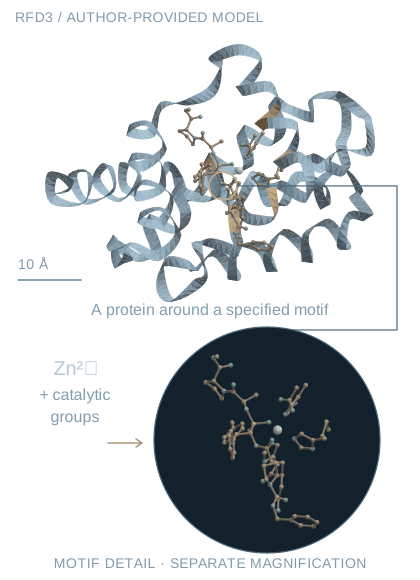
Specify important atoms. Generate a surrounding protein. Design its sequence, express it, and test its activity.
RFdiffusion3 · Science, 2026 Author-provided computed model · untested.
Atomically precise manufacturing
A world where nanofactories let us engineer machines and materials atom by atom.
Hi, I’m Andre. I’m researching the intelligence, chemistry, and manufacturing methods needed to bootstrap nanofactories, from the molecular machinery biology gives us to machines capable of building their own next generation.

What keeps me up at night is the possibility of a world of material abundance. For me, that starts with something I felt as a kid. I wanted to study the brain, understand neurological disorders, and figure out how we could intervene to help people. As an early teenager, I would get lost exploring unanswered questions and running simulations around optogenetics and physics. I wanted to understand what might be possible, then find experimental data to test those ideas against.
That feeling has never really gone away. Today, I can spend weeks running a molecular calculation and still be left with approximations that need checking against reality. Back then, I wanted better ways to investigate the brain. Now I also want better ways to investigate the molecules and machines that could help us build those tools. I keep coming back to the same frustration of having questions I can explore on a computer, but struggling to obtain the experimental evidence or physical capabilities needed to go further.
I keep finding that answering an ambitious question about the physical world eventually means building something. An idea reaches a point where moving forward depends on a material, a device, or an experimental tool we don’t yet know how to make or can’t access. The tools we build shape what we can discover, and those discoveries help us build the next tools.
That’s why I care so much about engineering matter. Better manufacturing could change which questions we’re able to ask and who gets to investigate them. There are so many problems I care about that I can’t possibly pursue them all. But helping people build the tools to pursue their own questions feels like a way to contribute to many of them. I want curious people to have more freedom to work with an AI on an instrument, a sensor, or an entirely new experimental system, then have a way to make it and find out what happens.
I imagine someone working with an AI to design a system that provides clean water for their town. They start with the contaminants they need to remove and the materials they have available. Together, they search through possible structures, reactions, and manufacturing routes, working backwards from the behaviour they want to something they can build and test. Somewhere else, someone is designing new computing hardware to make intelligence cheap and widely available, so more people can access a great education and pursue their curiosity. A community is making components for shelter, or developing systems to grow and produce food from the resources around them.
There is an enormous space of things we could make that we haven’t even thought to ask for yet. I want more people to be able to explore it. To work out what they need, investigate how it might function, and have a practical way to bring it into the world.
That’s the post-scarcity future I care about. A good life becomes easier to provide for, and more of our time can go toward learning, inventing, and taking care of each other. I keep thinking about what I would have done with those tools as a kid, and what the next generation might do if we help build them.
First, let’s define what we mean by a nanofactory.
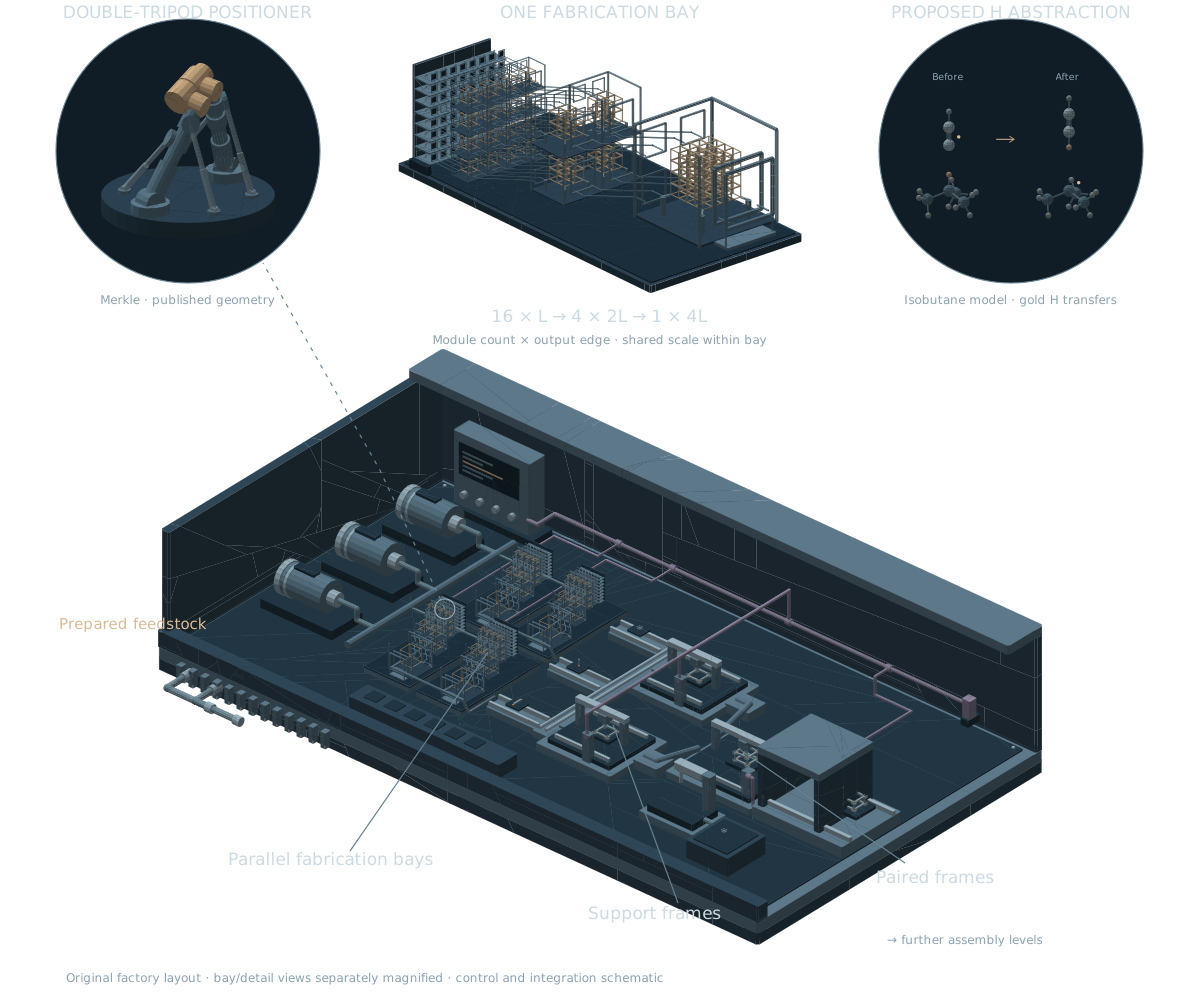
Imagine a machine you could send a design to and have it manufacture an object with control over its molecular structure. You supply prepared feedstocks and energy. Inside, molecular machinery carries out programmed chemical reactions, making precisely defined components that are assembled into larger structures.
From the outside, it might look like an enclosed piece of laboratory equipment. Inside, you would find many specialized manufacturing units working in parallel, with systems supplying materials, coordinating operations, and checking what they produce. Building something useful would require enormous numbers of these operations happening reliably together.
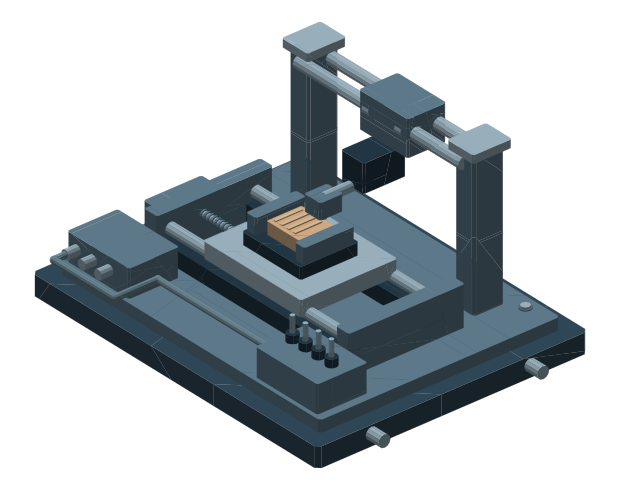
Functional context for holding, supplying and transferring a workpiece. The mechanism is schematic.
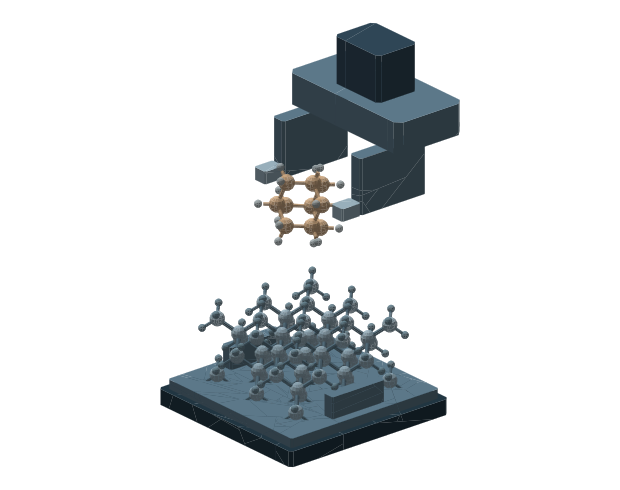
Geometry and access reference. Attachment and joining chemistry are unresolved; the proposed reaction is shown above.
That’s the kind of nanofactory I want to work toward. A proposed manufacturing system whose precision comes from controlling how molecules are positioned and bonded, allowing us to build structures that are difficult or impossible to manufacture with today’s tools.
I can imagine spending a lifetime exploring what becomes possible with that capability. But the machinery inside this factory would itself need to be made from precisely constructed molecular components. The tools, positioning mechanisms, and assembly systems all have to be manufactured somehow.
If a nanofactory is what we need to build those components, what do we use to build the first nanofactory?
That’s the bootstrap problem. We need a starting point we can manufacture with tools available today, then a sequence of increasingly capable systems that can help build what comes next.
For me, this starts with another question. What is the simplest nanofactory architecture capable of manufacturing the components needed to reproduce its own manufacturing machinery?
Which tools and operations are essential? How many different kinds of component would it need? What could we supply from existing laboratory equipment, and what would have to be built at the molecular scale?
Even a provisional design would give us something to work backwards from. We could identify the parts we need, investigate routes to synthesize and assemble them, and ask whether biological machinery could help produce the first generation. The chemistry would also push back on the design. A component that looks elegant in a simulation might be extraordinarily difficult to make, while a different architecture could achieve the same function with much simpler parts.
I’m developing the factory design and its bootstrap route together.
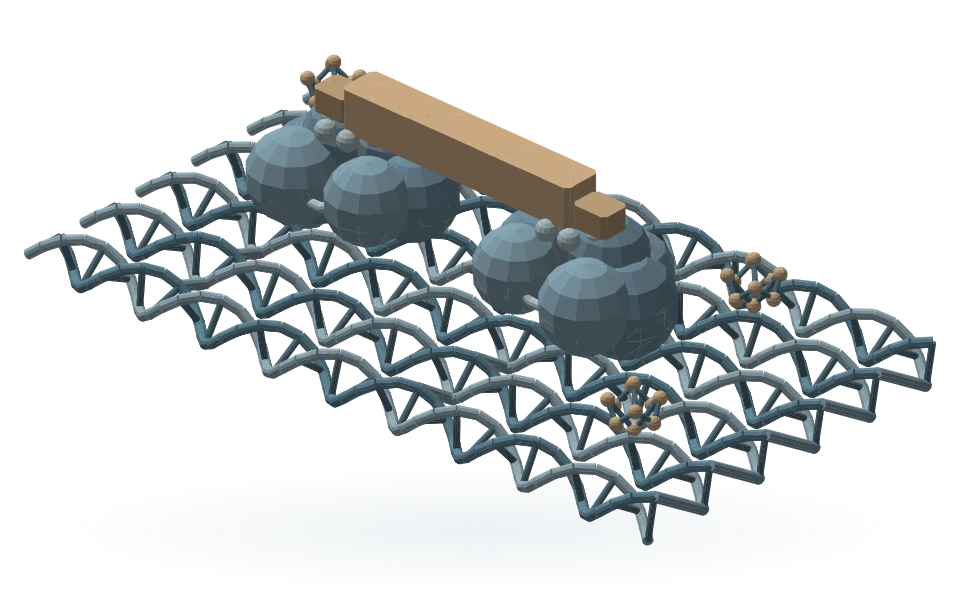
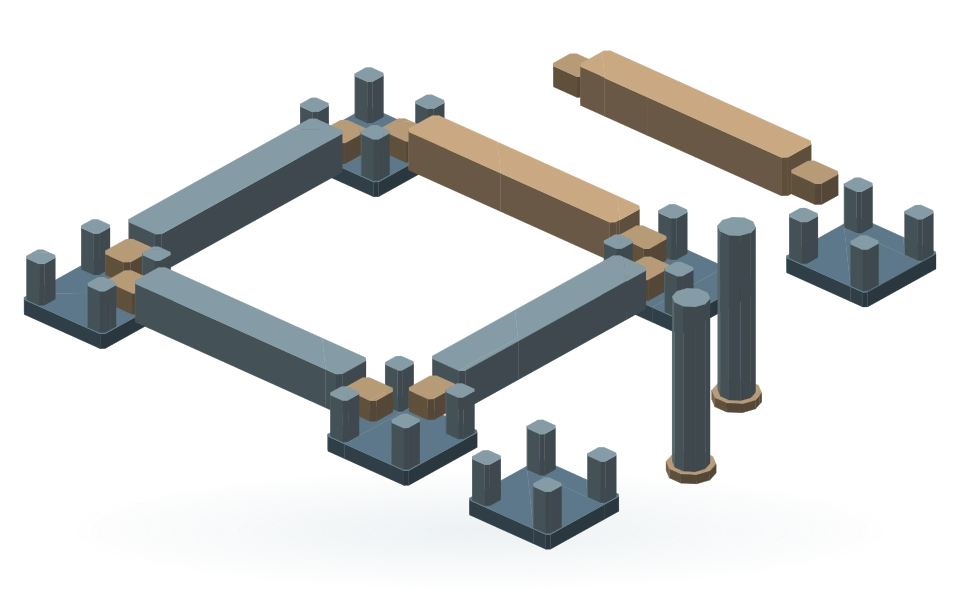
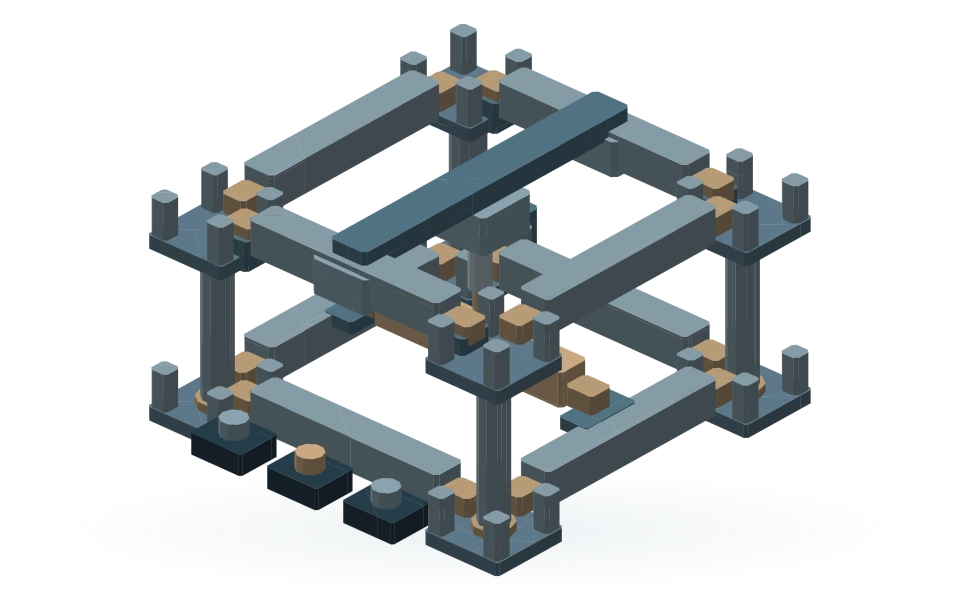
The earliest systems might perform only a small set of operations, with substantial help from laboratory equipment. Those operations would need to produce something that expands what we can build next. A scaffold might help organize the components of a positioning mechanism. That mechanism might give us enough control to construct a more rigid tool. The new tool might support reactions, forces, or operating conditions that the original scaffold could never tolerate.
That’s the generation-to-generation progression I am investigating. Each generation would help manufacture machinery with capabilities beyond its own, allowing us to attempt more complex structures and a broader range of operations. Eventually, I want to understand whether that sequence could reach a factory capable of producing another generation of its own manufacturing machinery, given suitable feedstocks, energy, and external support.
Reproducing a useful manufacturing unit could then let us make many copies that work in parallel. Those units could specialize in different components and feed larger assembly stages. We would need to develop the organization and control alongside the tools themselves, so growing manufacturing capacity actually translates into more complicated things we can reliably make.
Feedstocks, energy, equipment, and human-guided design.
Catalysts and scaffolds as a starting point.
Components for positioning and support.
New operations and operating conditions.
Repeated units feeding larger assembly.
Later tools could manufacture components for another generation of machinery.
People have been working through these questions for decades. Drexler’s Engines of Creation opened up the possibility of a world transformed by molecular manufacturing. His later book, Nanosystems, worked through the mechanics in much greater detail, examining how molecular components might move, how thermal motion affects positioning, and how controlled chemical reactions could become manufacturing operations. It also explored development paths from simpler molecular systems toward more capable machinery.
Ralph Merkle and Robert Freitas developed proposals for diamondoid manufacturing and self-replicating machinery. David Deutsch’s constructor theory approaches a broader question about which physical transformations are possible and what makes them possible. These are different contributions, but they give me a great deal to think with. They also leave an enormous amount of engineering to do.
The first generation could depend heavily on laboratory equipment, externally supplied energy, and carefully prepared feedstocks. As its capabilities grow, I want to understand which of those dependencies it could take over. Every proposed route has to account for how the tools themselves are made, maintained, and replaced.
A factory could contain many specialized machines that collectively produce another factory. That still leaves some very difficult questions. How do parts reach the right places? How are operations programmed and coordinated? What happens when a reaction fails? How much error can the next assembly step tolerate? Can we inspect a faulty component, repair it, or replace it before it compromises everything built around it?
Working backwards from a minimal factory gives me something concrete to search for. But even a single component can open up an enormous number of possibilities.
Take a mechanism that needs to hold a molecule in position for a reaction. What should it be made from? How should it grip the molecule? How much will it move at its operating temperature? Can it withstand the forces involved, release the product, and return to a state where it can do the same thing again?
Every choice introduces others. Changing the material changes the chemistry available to manufacture it. Changing the attachment point can affect its stiffness or block access for the next reaction. A synthesis route might produce the right structure but leave behind contamination that prevents it from functioning. And all of this has to remain compatible with the machinery around it.
The search grows across possible components, their interactions, and the sequences of operations that could bring them into existence. Even if we could evaluate each possibility quickly, we would still need a useful way to decide which ones deserve our attention.
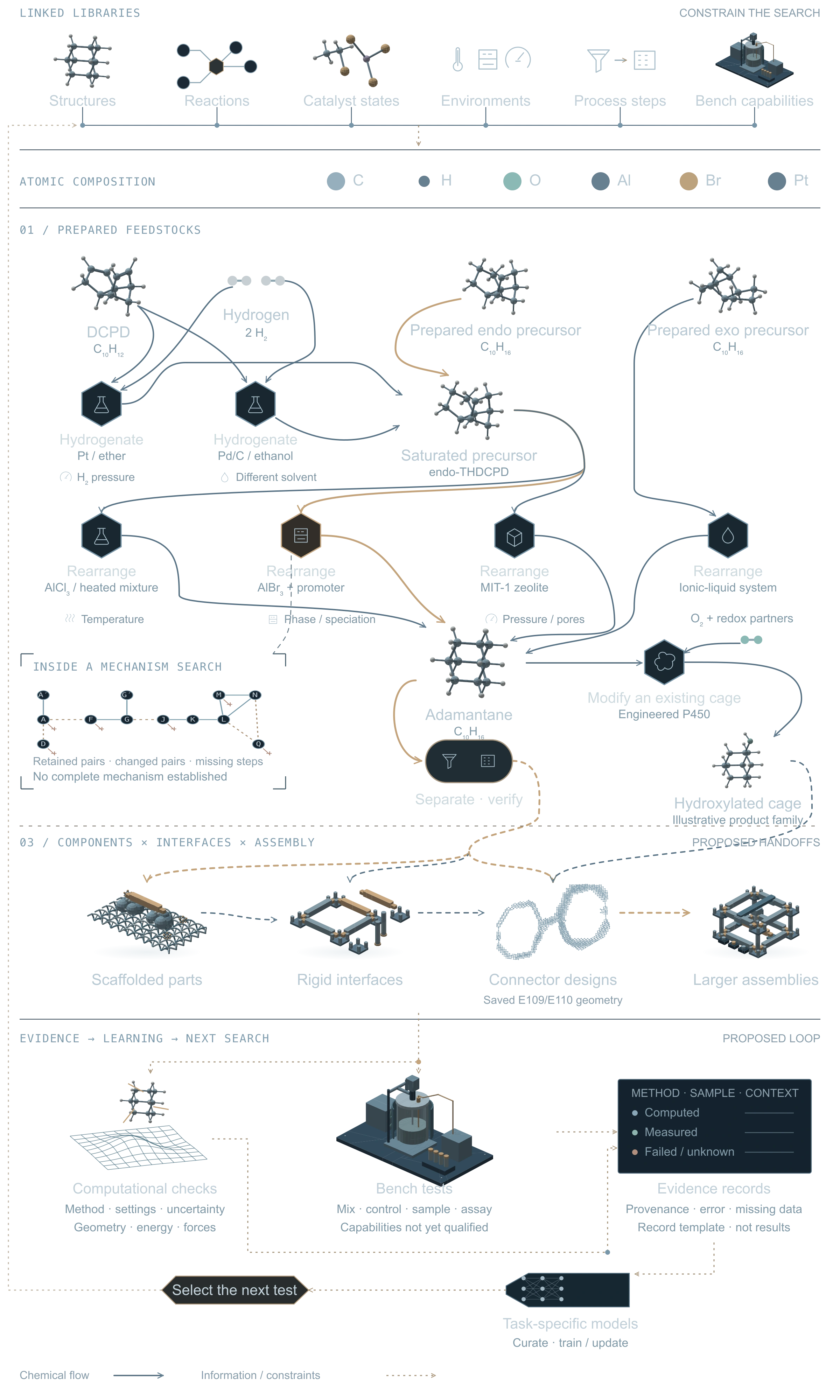
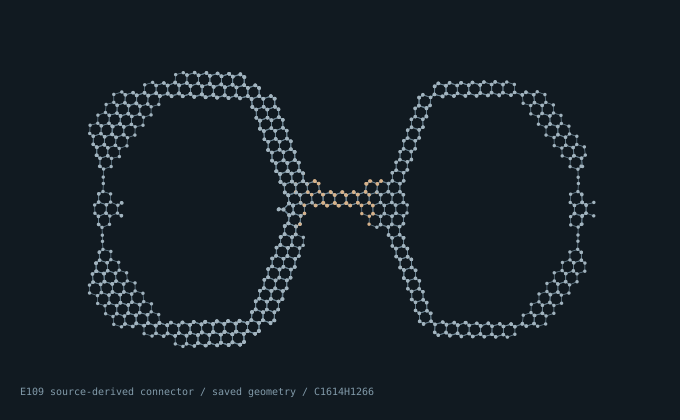
Drawn from the notebook’s bootstrap registry and N1 reaction-network audit. Molecular structures reuse saved computed conformers. The inset preserves retained and changed endpoint pairs and unsuccessful searches; none establishes a verified reaction path. The E109/E110 connector is a saved computational design, with no demonstrated synthesis route from these feedstocks.
The enzyme branch modifies an existing cage; O₂ and redox partners are abbreviated co-inputs, with other reagents and coproducts omitted. The hydroxylated structure illustrates a product family and does not claim enzyme selectivity. Scaffold, interface and assembly thumbnails are conceptual designs, shown at independent magnifications.
The linked libraries and learning loop describe a proposed research workflow. The bench drawing reflects the notebook’s apparatus, cooling-loop, sampling and assay requirements, which remain unqualified. It illustrates a jacketed-vessel option; it does not select equipment or show an installed laboratory. Computations and experiments retain separate provenance, settings and uncertainty. The evidence ledger, energy surface and model network are schematic, not measured results or a trained system.
This is where I keep running into the computational problem. We can derive relationships, use approximations, and build simplified models to narrow the possibilities. But the details we leave out can matter enormously when a design depends on a particular bond forming, a competing reaction being avoided, or a mechanism staying within a small positional tolerance. More detailed calculations can help resolve those questions, but become expensive to repeat across a large search.
I’m interested in how much useful knowledge we can carry from one calculation or experiment into the next. If we spend substantial compute understanding a reaction, I want that work to help us recognize related reactions, identify likely failure modes, and choose better candidates elsewhere. That requires datasets that preserve the conditions and intermediate configurations behind a result, including unsuccessful attempts and the limits of the methods used to evaluate them.
AI could help us discover relationships across that evidence and guide the search through designs and manufacturing routes. The difficult part is developing models we can trust for the decisions we’re asking them to make, and recognizing when we need a better calculation or a physical experiment.
Work such as GNoME and MatterGen gives us examples of machine learning expanding the space of candidate materials. A-Lab connects proposed synthesis recipes with robotic experiments and measurements. For molecular machinery, I’m interested in extending that connection across a component’s intended behaviour, the steps required to manufacture it, and the evidence that those steps actually work.
I also think this is a problem many people should be able to contribute to. Drexler’s Molecular Systems Engineering Platform proposal explored making molecular design more accessible and collaborative. I imagine a shared environment where someone can contribute a mechanism, another person can investigate its synthesis, and someone else can test an assumption that both designs depend on.
A useful result could be a working component, a reproducible reaction, or an explanation of why a promising route fails. Each could save someone else from starting over and help us narrow the search for a factory we can actually build.
A search like this becomes much more useful when we can anchor it to something someone has actually made.
There are already experiments worth building around. A 2026 preprint reports using inverted scanning tunnelling microscopy to transfer two-carbon units onto prepared silicon surfaces and build carbon chains through successive bond-forming steps. Being able to position reactants and deliberately extend a structure gives us a physical starting point for investigating molecular construction.
What interests me is how much we can learn around an operation like that. Under which conditions does it succeed? How sensitive is it to positioning, surface preparation, or the state of the reactants? What unwanted outcomes appear? Measurements like these could help us check our computational predictions and understand which details our models need to capture.
Then we have to investigate whether the operation can fit into a longer manufacturing sequence. After forming a bond, can we prepare the tool for another cycle? Can we reach the next reaction site without disturbing what we have already built? As a structure grows into three dimensions, access becomes a design constraint. Eventually, we need ways to release components, move them, and connect them into working mechanisms.
The surrounding equipment matters too. An operation performed with a carefully controlled scanning probe can teach us valuable chemistry. Scaling that capability requires figuring out which functions must remain in the external apparatus and which could eventually be performed by smaller manufacturing units working in parallel. Supplying reactants, preparing tools, and identifying failed operations all become part of that problem.
I’m investigating which early operations could become useful building blocks for a bootstrap route, and what infrastructure each would require. That also makes me wonder how much of the first generation we could construct using molecular machinery that already exists in biology.
Every living cell is full of molecular machinery that builds other machinery. Ribosomes assemble proteins from encoded instructions. Enzymes bring reactants into arrangements that favour particular chemical transformations. Those proteins become parts of systems that transport materials, supply energy, and keep the cell functioning.
I find that extraordinary. We’re trying to work out how to manufacture molecular machines, while depending on them for every moment of our own existence.
The question I’m investigating is which of those capabilities we could engineer into a useful starting point for a nanofactory. Could an enzyme help synthesize a precursor we need? Could a molecular scaffold organize components that would otherwise be difficult to assemble? What would we need to change for those components to become part of a working manufacturing tool?
There are already examples to learn from. Researchers have used DNA templates to organize carbon nanotubes into electronic devices. Engineered enzymes can catalyse selected carbon–carbon bond-forming reactions. Methods such as RFdiffusion3 let researchers design protein structures around specified atomic arrangements, including catalytic sites. Recent experiments have produced active enzymes from these designs, giving us more ways to investigate molecular tools for particular chemical jobs.
Specify important atoms. Generate a surrounding protein. Design its sequence, express it, and test its activity.
RFdiffusion3 · Science, 2026 Author-provided computed model · untested.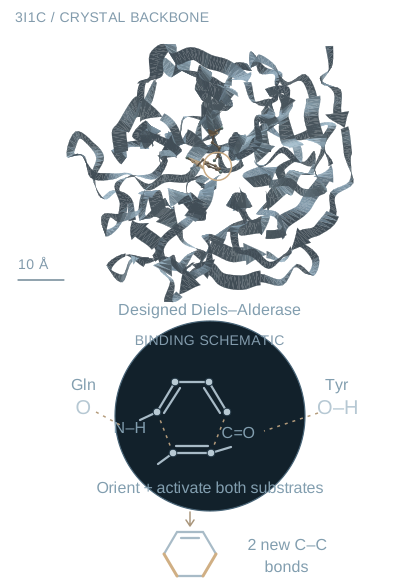
A designed Diels–Alderase positions two substrates to make a ring with two new carbon–carbon bonds.
Siegel et al. · Science, 2010 Crystal backbone · separate binding schematic.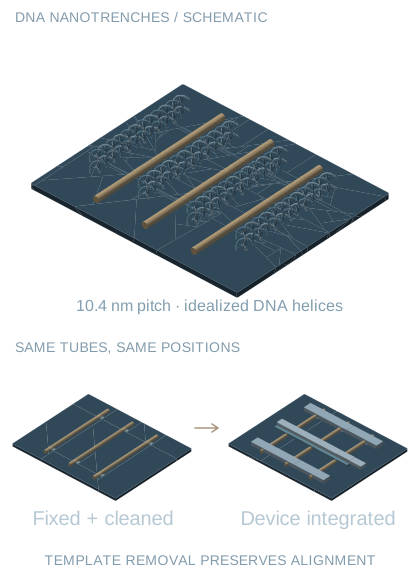
DNA templates align carbon nanotubes. Fixing, cleaning and conventional fabrication make the array useful.
Chen et al. · Nature Protocols, 2023 Idealized trench section · unchanged tube positions.
The RFdiffusion3 illustration reuses an author-provided metalloprotease tutorial model, with zinc, a phosphonamidate transition-state analog and specified catalytic groups. It is a computed example, not a tested enzyme or evidence that every design constraint was met. The larger view and motif detail use separate magnifications.
The Diels–Alderase backbone and highlighted side chains use crystal structure 3I1C. Its deposited ligand is glycerol; reaction substrates are not present. The binding schematic is a separate illustration of the paper’s catalytic design logic, with abbreviated groups and stereochemistry, not a docked pose or measured trajectory.
The nanotrench, DNA helices, fixation symbols and device are illustrative geometry. The 10.4 nm pitch is source-reported; the three tubes represent a section and retain identical coordinates across the three views. These figures do not establish a common scale, synthesis route or molecular positioning accuracy across the studies.
These capabilities address different parts of the problem. Organizing components with DNA does not automatically give us control over their bonding, and catalysing one reaction does not establish an entire construction sequence. I’m interested in finding combinations that can carry us through a useful sequence, with compatible conditions at every step.
Biomolecular systems also offer ways to perform many operations in parallel. Many copies of a catalyst can act at once, while molecular recognition and self-assembly can help organize components without individually positioning each one with an external probe. Making that useful for our designs requires controlling unwanted interactions, measuring yields, and finding ways to separate working products from failed assemblies.
This gives the computational work a more concrete task. We can investigate a particular precursor, reaction, or assembly step, identify the uncertainties that matter, and use calculations and experimental evidence to narrow the choices. The results would help us decide both what to attempt next and what our models still need to learn.
There are important boundaries. Proteins and DNA are flexible, and their function depends on their environment. A later manufacturing step might require temperatures, solvents, reactive species, or mechanical forces that the biological components cannot withstand. We would need to account for how a product is released, transferred, and used after the machinery that helped make it has been removed.
That’s where I see a possible transition toward more rigid, inorganic manufacturing tools. Biological machinery might help produce or organize an early component, which could then operate under conditions that expand what we can manufacture. The handoff itself is a research problem, and finding a workable one would be a meaningful step.
What keeps me interested is the possibility of starting with molecular capabilities we can access today and engineering our way toward ones we don’t yet have. I’m investigating where biology could give us that first foothold, and what it could help us build beyond itself.
What draws me toward this is the possibility of choosing a material’s structure as deliberately as we choose a machine’s design. If we could manufacture the arrangements we need, which properties could we turn into useful devices?
Carbon makes that question tangible. Graphite and diamond are made from the same element, yet their bonding gives them very different properties. In graphene nanoribbons, the width and atomic structure of the edges help determine electronic behaviour. The arrangement becomes part of the engineering.
Layered · sp² bonds
Tetrahedral · sp³ bonds
A thin sheet with defined edges
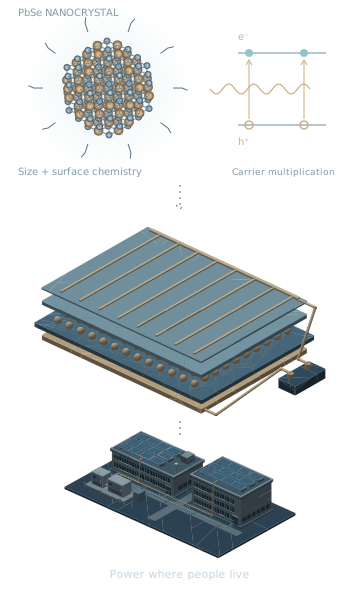
Engineer how light becomes usable charge. Imagine solar skins powering homes, tools and local manufacturing.
Carrier multiplication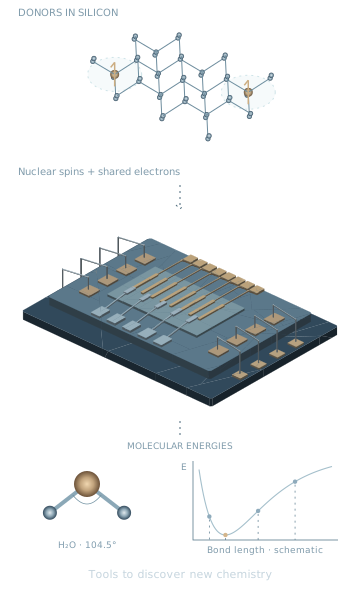
Control interacting quantum states. Imagine exploring molecular reactions that help us discover the next materials and machines.
Atom-based quantum processor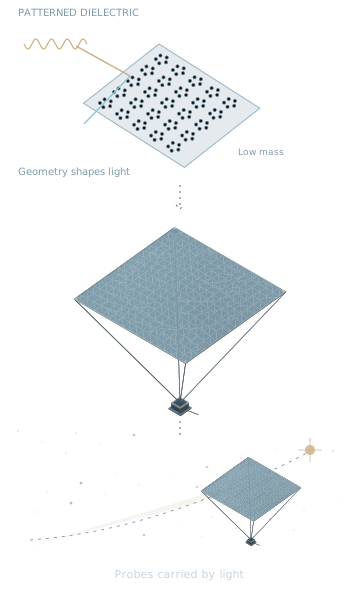
Design how a material exchanges momentum with light. Imagine ultralight probes carrying our curiosity beyond the solar system.
Nanophotonic lightsail materialsThe challenge is carrying the useful physics into a working system.
Graphite’s layer slip and in-plane heat flow are distinct behaviours. Undoped diamond is an electrical insulator and thermal conductor; the gold pulses represent heat, not charge. The diamond bending detail represents a separately magnified nanoneedle, not flexible bulk diamond. Its bending and the ribbon’s deformation are illustrative, not simulations of strain. Ribbon electronics depend on width, edge structure, contacts and gate conditions.
The solar view uses an idealized PbSe rocksalt nanocrystal, not a carbon quantum dot. Some sufficiently energetic photons can generate multiple electron–hole pairs. This does not imply greater than 100% energy conversion, nor that every photon produces two pairs. Surface passivation, recombination, transport and collection matter.
The quantum view uses an ideal diamond-cubic silicon lattice with illustrative substitutional donors. It is not the geometry of the cited 11-qubit device. The control fields, gate stack and molecular application are schematics. The water molecule uses NIST’s gas-phase equilibrium geometry; the energy curve is qualitative, not a calculated or measured result. Useful molecular simulations require adequate qubit count, precision, control and error management; no general quantum speedup is implied.
The sail uses illustrative fivefold patterns inspired by published silicon-nitride photonic-crystal work, not the paper’s exact mask. The propulsion mechanism is photon momentum transfer from an external laser. The probe, membrane curvature and tethers do not establish a flight-ready design, launch system or interstellar travel time.
Graphitic heat spreading · Diamond nanoneedles · Graphene bending · Nanoribbon transistors · Illustration provenance
That’s why I’m interested in working at this scale. Some capabilities depend on particular bonds, interfaces, and geometries. To use them reliably, we need ways to manufacture the features responsible for their behaviour.
But making an interesting molecular structure is only part of the challenge. We need to preserve what makes it useful as we connect it to other components and build larger systems.
A precisely made electronic component still needs contacts, insulation, and a manufacturing process that leaves it functioning. A molecular mechanism needs supporting structures that hold its moving parts in the right relationship. The interfaces between components can become as important as the components themselves.
This is where I see molecular construction and existing manufacturing working together. Lithography, deposition, chemical synthesis, and microfabrication already give us powerful ways to produce structures and connect devices. I’m investigating how molecular methods could supply features that remain difficult to make with those processes, and how we could integrate them without losing the properties we wanted.
The precision we need will depend on the design. Some regions might tolerate substantial variation, while a particular interface or reaction site demands much tighter control. Deliberately introduced defects can also be useful. Understanding those tolerances could help us concentrate the hardest manufacturing work where it actually changes performance.
Then comes the challenge of building enough of it. We need ways to manufacture components in parallel, organize them in three dimensions, and assemble them into larger structures while preserving the relationships that make them function. A material’s properties at a small scale do not automatically survive that process.
I keep thinking about how much of the space of possible machines remains difficult to explore because we cannot manufacture their essential features. Better control over matter could let us investigate more of that space, from new computing hardware to instruments that help us study the physical world.
That’s what makes the bootstrap problem worth pursuing for me. Every useful manufacturing capability could expand the set of things we can build, including the tools that let us take the next step.
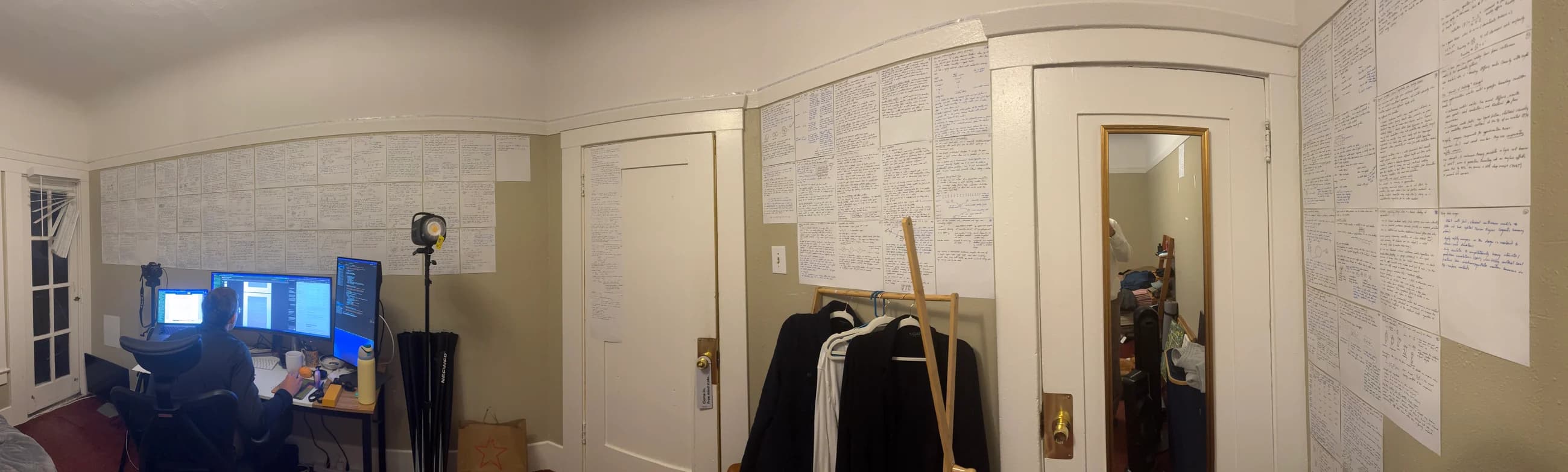
I’ve built companies around scientific AI, healthcare, and digital automation, and have worked on biotech research and machine learning projects since 2018. These questions have stayed with me through all of it. I want to give them a real shot. Merion is my independent, self-funded research thesis, and I’m putting my time and resources into it because I care about living in a future where these capabilities exist.
I haven’t built a nanofactory. Much of what I’m describing remains an open research problem, and I can’t promise that the route I’m investigating will work or lead to a commercial product. I can commit to doing the work carefully, being clear about what the evidence supports, and sharing what I learn.
This research builds on decades of work by people who took these possibilities seriously long before I encountered them. Reading their ideas changed what I thought was worth attempting. I’d love for something I contribute to have that effect on someone else.
A useful outcome could be a manufacturing step another researcher can build on, a dataset that helps them explore better designs, or a clear account of why a promising approach failed. Even if the larger vision takes generations, those contributions could give the next person a better place to start.
And if a curious teenager finds this work, starts asking their own questions, and eventually takes it somewhere I couldn’t, that would mean a great deal to me.
There are more questions here than I could answer in a lifetime. I’m choosing to work on them because I want to help make that future possible, and leave something useful for the people who carry it further.